





















The arrest of Jyoti Prakash Pandey, Chief Executive Officer of Nepal Investment Mega Bank (NIMB), has created significant concern not only within the banking industry but also across Nepal’s wider private sector. The Central Investigation Bureau (CIB) has taken Pandey into custody on allegations of fraud and criminal breach of trust related to the mortgage auction process of Smart Telecom. The investigation centers on alleged misuse and irregularities involving government-controlled assets. However, banking institutions, business leaders, and private sector representatives have interpreted the move as excessive state interference in a routine loan recovery process.
According to NIMB, the recovery proceedings involving Smart Telecom were conducted fully in compliance with existing laws. The bank stated that the Bank and Financial Institution Act, 2017 clearly authorizes banks to recover outstanding loans through collateral auctions. NIMB published the auction notice on Asoj 3, 2082, and reported that assets worth approximately Rs 4.6 billion have since been sold. Of this amount, Rs 4.22 billion was used to settle the outstanding loan, while the remaining Rs 380 million has been retained in an Earnest Money Account to address liabilities such as landlord dues and electricity payments. The bank clarified that disbursement of these funds would occur only after claims are submitted with supporting evidence.
Section 57 of the Act grants banks explicit authority to auction collateral when borrowers fail to repay loans. The Smart Telecom loan was issued in 2074 BS under a consortium financing arrangement led by NIMB. The bank maintains that it initiated the auction process only after repeated failures by the borrower to repay both principal and interest, and after receiving written authorization from the borrower on 20 Bhadra 2082 BS permitting the bank to recover dues through collateral liquidation.
Despite these claims, the CIB has proceeded with an investigation, arguing that government-controlled assets may have been improperly handled during the auction process. While officials acknowledge that banks possess legal authority to auction collateral, they contend that investigations are warranted if irregularities are suspected. At the same time, concerns are growing regarding the legal boundaries of such investigations and their broader implications for the economy.
The incident comes amid increasing tension between the government and the private sector. Over the past month, several prominent business figures have been arrested on allegations ranging from insider trading and money laundering to contract irregularities and cybercrime. In connection with the Himalayan Reinsurance case, authorities detained business leaders including Shekhar Golchha, Deepak Bhatt, Shankarlal Agrawal, and Sulabh Agrawal. While some have since been released, the broader message perceived by the private sector is one of growing insecurity and uncertainty.
Leading business organizations, including the Federation of Nepalese Chambers of Commerce and Industry, the Nepal Chamber of Commerce, and the Confederation of Nepalese Industries, have jointly warned that the country’s investment climate is deteriorating.
The construction sector has experienced similar tensions. Pitambar Badu, Managing Director of Lama Construction, was reportedly escorted to the Ministry of Physical Infrastructure through police involvement while en route to a hospital. Likewise, Ramesh Sharma of Sharma & Company was summoned for questioning regarding project progress. Construction entrepreneurs argue that projects are already under severe strain due to rising material costs, shortages of bitumen, fuel supply disruptions, and local-level obstructions. They contend that the government is prioritizing investigations over practical solutions.
In response, the Federation of Contractors' Associations of Nepal has launched a protest movement. The federation has organized sit-ins and memorandum submissions at various government departments and offices, demanding government intervention to address escalating costs of fuel, transportation, construction materials, and labor, which they attribute partly to the ongoing conflict in West Asia. The federation has warned that construction work may come to a standstill if these issues remain unresolved.
The government, however, has defended its actions, asserting that the economy has long been dominated by a limited group of influential actors. Officials maintain that the administration, led by the Rastriya Swatantra Party-led government, has adopted strict measures against corruption and financial irregularities as part of broader governance reforms. Nevertheless, these actions have significantly widened the trust deficit between the state and the private sector.
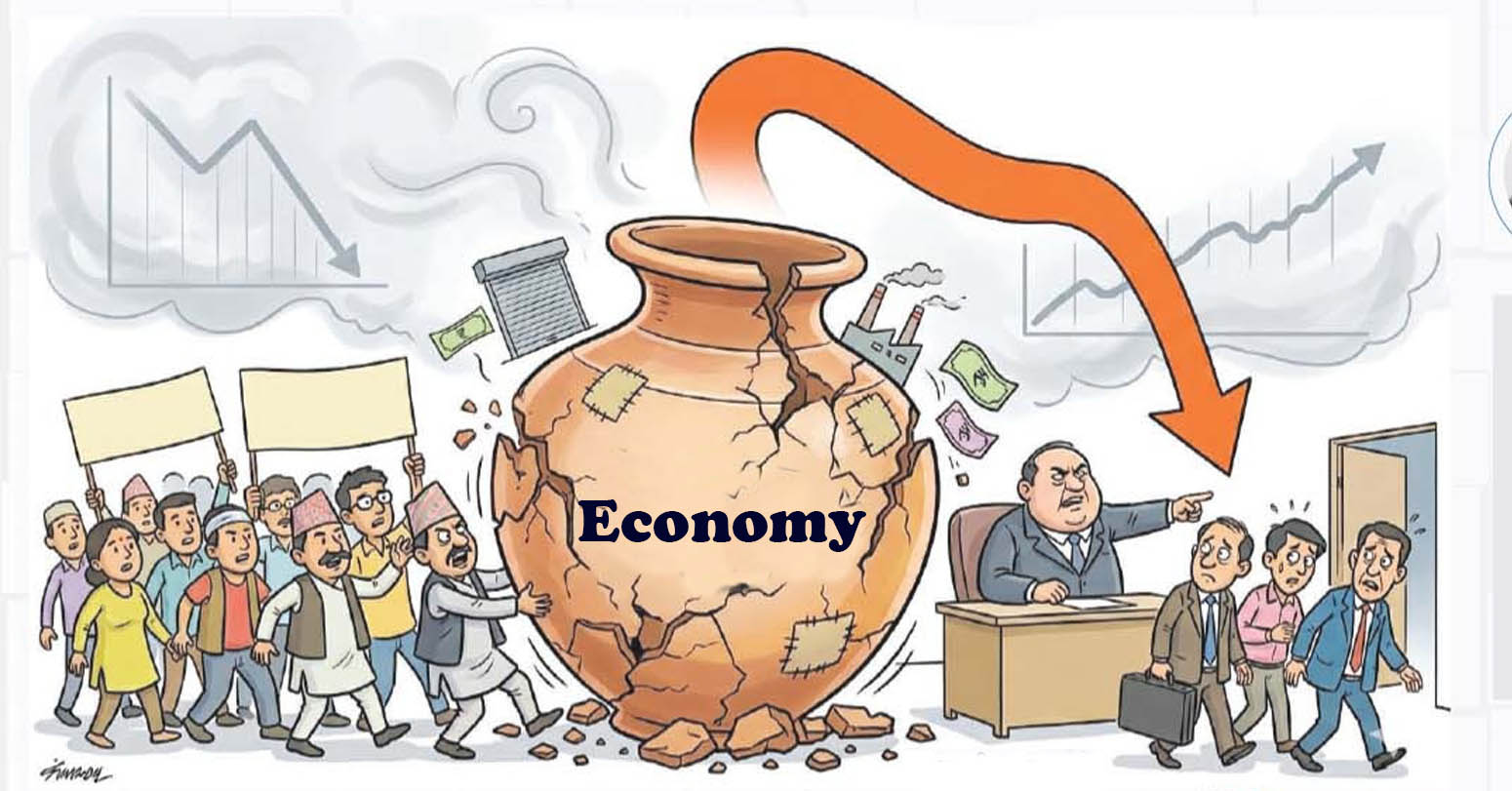
Nepal’s economy, which had begun recovering after the COVID-19 pandemic, is once again facing uncertainty. Political unrest and anti-establishment movements had already weakened investor confidence and caused substantial economic damage. Although expectations initially rose following the formation of a strong government with near two-thirds parliamentary support, the recent crackdown on private sector actors has renewed fears among investors, bankers, industrialists, and construction entrepreneurs.
The arrest of the NIMB CEO has therefore evolved beyond a purely legal matter and become a broader question of trust between the state, the banking system, and the private sector. Diverging interpretations of the law have intensified tensions, and stakeholders increasingly fear that the growing disconnect between the government and the private sector could pose a long-term threat to Nepal’s economic stability.
Adding to these concerns, Ram Kumari Jhakri criticized the government during a National Assembly session, accusing it of fostering fear and panic instead of creating an enabling environment for businesses. She argued that the government’s actions were discouraging economic activity and undermining confidence within the private sector.
Meanwhile, four major banking umbrella organizations — the Nepal Bankers Association, Development Bankers Association Nepal, Nepal Financial Institutions Association, and Nepal Microfinance Bankers Association — issued a joint statement objecting to Pandey’s arrest. Citing Section 57 of the act, they emphasized that loan recovery through collateral liquidation falls within the legitimate operational authority of banks and forms part of a CEO’s core responsibilities.
The organizations further warned that arresting senior banking officials for carrying out standard banking procedures could undermine public confidence in the financial system and damage the reputation of the banking industry. They urged authorities to respect the legal principle of “Sun and Thun” by allowing investigations to proceed without custodial detention and called for Pandey’s immediate release while the inquiry continues.
Janai Purnmina Being Marked Today
Catastrophic Flash Flood In Bhotekoshi
Water Level Again Increases In
Forgiveness Ritual Held At Palanchowk
Rasuwa’s Road Connection Restored
Bhotekoshi Flashflood: Rs 1.91 Billion