











- Sweekriti Dangi
388 women out of 3,406 under the First-Past-The-Post (FPTP) system in the House of Representatives Election 2082 is a stark reflection of the persistent gender gap in direct electoral representation. With local and provincial elections approaching, one thing is no longer negotiable i.e. women must contest and win on equal ground. Not as a political favor. Not through the PR backdoor. Rather as a constitutional and democratic compulsion.
Nepal went to the House of Representatives election on March 5, 2026. A country of majority of women, a democracy proud of its hard-won constitutional rights fielded 3,406 candidates for election. Of those, only 388 were women. That is 11.39%. And if you strip away the 157 who ran as independents, political parties which are powerful, established institutions that hold the keys to elect ability trusted only 231 women to carry their banner in a direct contest. The numbers are not just disappointing and disturbing. They are a structural indictment of how Nepal's political parties view women as instruments for quota compliance but not as leaders deserving of power.
52.1% Women’s population
11.39% Women given direct candidacy
48.88% eligible women voters
74.5% Women representative through PR seats (110 total)
Let’s look at the data side by side for a moment and reflect on the contradiction. Women make up nearly half of all registered voters ( 9,240,131) whose choices shape the future of the country. Their votes are sought, their turnout is counted, their numbers are cited by parties when claiming democratic legitimacy. But when the time comes to distribute election tickets, women are pushed aside. Suddenly, they are treated as secondary choices, while men continue to dominate the main political stage. This data from the last House of Representatives election is not just disappointing, it is a warning sign for the elections ahead.
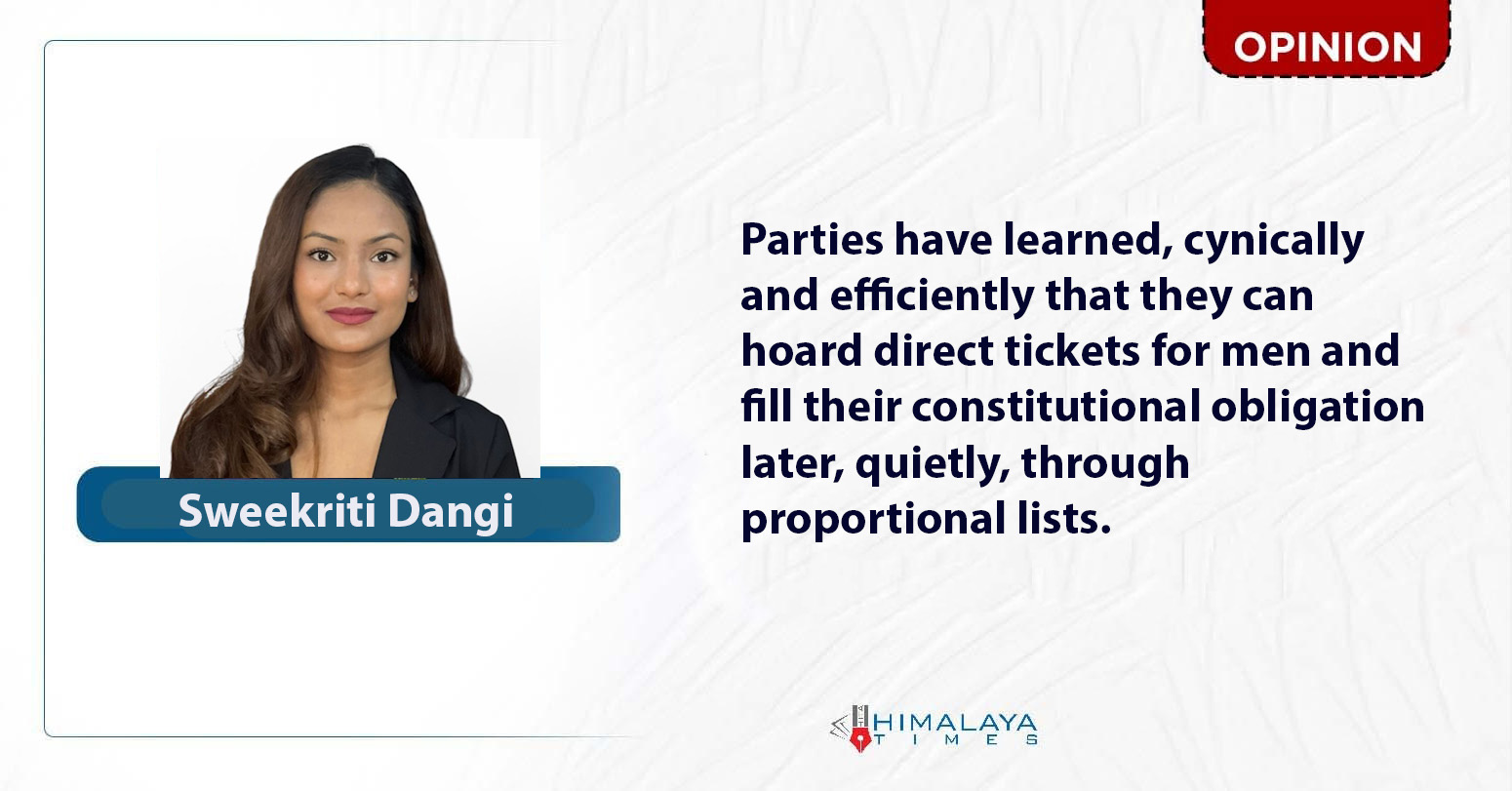
Nepal's constitution providing mandate for one-third women's representation in parliament is a provision celebrated as progressive, even visionary. Without it, women's presence in the legislature would have been devastatingly thin. The PR system, which fills seats proportionally after direct elections, ensures the constitutional floor is met. But this is the scandal hiding inside the achievement. In the 2025 election, 82 out of 110 PR seats (74.5%) went to women, precisely because direct elections failed to produce sufficient women representation. Only 14 women (8%) won directly in election. The PR does not empower women rather it provide relief to political parties from the responsibility of ever having to try and normalizes ‘why invest in identifying, grooming, funding and backing strong women candidates in constituencies when the back door of PR exists?’ Parties have learned, cynically and efficiently that they can hoard direct tickets for men and fill their constitutional obligation later, quietly, through proportional lists.
The result where the parliament technically meets the 33% of women threshold have been failing morally. And until women win direct seats in representative numbers, they will remain guests in Nepal's democracy rather than architects of it.
What Is at Stake in the Upcoming Elections
Local and provincial elections are coming. These elections decide who controls schools, roads, water systems, health clinics, land rights and the everyday machinery of governance that most directly shapes women’s lives. At this level, power is not distant, it is immediate. Ward chairpersons, municipal mayors and provincial assembly members sit at the very closest to the ground. They are also the foundation of the political pipeline. What happens here determines who rises, who is visible and who is eventually considered fit for national leadership. If women are excluded at this very stage, they are not simply missing from local offices. They are removed from the starting point of political advancement itself so the pipeline is not corrected later rather it collapses at its base.
This is also the most correctable layer of the problem. Local elections are shaped more by trust, closeness, proximity and everyday presence in the community. These are precisely the forms of leadership that women in Nepal have long exercised through generations of civic and social labor, often unpaid and politically unrecognized. The barrier is clearly not competence. Across South Asia, evidence consistently shows that when women are nominated and meaningfully supported by political parties, they perform at levels not less than men. This shows the real constraint lies access to tickets and who gets to control that access.
Political parties still continue to choose the familiar, the powerful and mostly men. In doing so, they decide not just who wins elections, but who even gets the chance to stand. The change is not far away. It begins when parties stop rewarding old habits and start recognizing the leadership women show in their communities.
This Time Must Be Different
Political parties now have a responsibility to move beyond token inclusion. First, parties must commit to a minimum percentage of women candidates in direct elections not just in proportional lists. Second, women must be given competitive constituencies instead of politically weak areas where defeat is already expected. Third, parties must invest in long-term political leadership development for women at ward, local, district, and provincial levels instead of searching for female names only during election season. Fourth, election monitoring bodies, civil society organizations, media, and citizens must begin publicly questioning parties not only about who won elections but about who was denied the opportunity to contest fairly.
Because silence has allowed this imbalance to survive for too long. Nepal cannot continue treating women’s leadership as an exception while treating male leadership as the default setting of politics. The next election should not only focus on how many women enter assemblies after the results. The real focus should begin before the election itself:
How many women are receiving direct tickets?
How many are contesting from winnable constituencies?
How many are being treated as serious candidates instead of symbolic figures?
The upcoming elections therefore present Nepal with a serious democratic choice. Will political parties once again hide women behind proportional representation while preserving direct political power for men? Or will this finally become the election where women are trusted not just to participate in democracy but to compete, lead and win equally within it? Not, the coming election will determine whether Nepal’s commitment to inclusion is truly political reality or merely constitutional decoration.
Additionally, the voters also have an important role to play. When a woman stands as a candidate whether from a major party or independently she deserves the same seriousness, trust and fair evaluation as any male candidate. Voting for a woman is not an act of sympathy or charity. It is a step towards correcting a political imbalance that has existed for far too long. And in many cases, it is support for someone who had to struggle far more than her male counterparts just to reach the ballot paper.
Nepal has done many things right. A federal democratic republic after decades of conflict. A constitution that enshrines gender quotas. A law that ensures parliament where women hold meaningful numbers. These are not small achievements, they were brought with sacrifice. But achievements on paper must become reality on the ground and the ground-level reality is painful. And, this 11.39% women candidacy stands as a mocking reminder of your so called law of inclusion and equality until Nepal fix this in next election. The women of Nepal are not requesting a reserved corner of democracy. They are demanding what was always theirs, the right to contest on equal terms that actually matters. The direct vote. The hard fought constituency seat. The voice. And, the mandate earned from the people not assigned from a party list.
Upcoming local and provincial elections are the moment to begin rewriting the story. Not later, and not after policies are written but now in coming election through real political will exercised in the rooms where party tickets are decided and in the conversations that determine who gets chance to run and win.
I truly believe that “Democracy is not a building with a backdoor reserved for women. It is a stage. Give them the microphone.”
The writer is a law student and youth leader.
Janai Purnmina Being Marked Today
Catastrophic Flash Flood In Bhotekoshi
Water Level Again Increases In
Rasuwa’s Road Connection Restored
Forgiveness Ritual Held At Palanchowk
Bhotekoshi Flashflood: Rs 1.91 Billion