















Kathmandu, April 23: With the formation of a new government led by the Rastriya Swatantra Party (RSP), politicians, diplomatic community, development practitioners, and the general public have been closely watching how its policies and development pathways will unfold in the coming years. Much of this interest focuses on good governance, foreign policy, and other key areas.
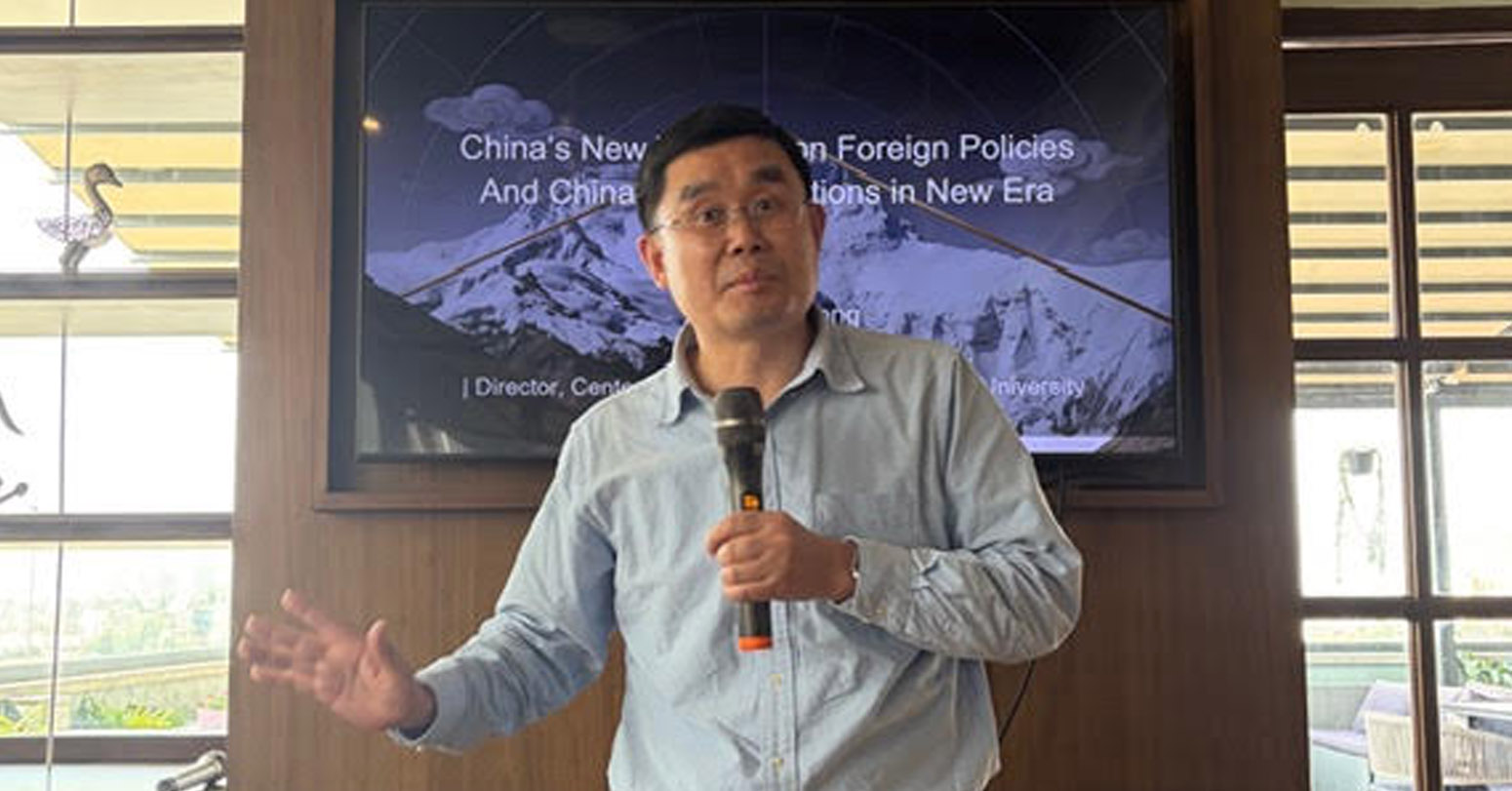
During his recent visit to Nepal, Professor Zhang Jiadong, Director of the Centre for South Asian Studies at China’s Fudan University, sat down with Senior Editor of Rastriya Samachar Samiti, Mahendra Subedi, for an open and candid discussion on Nepal–China relations, future cooperation between the two countries, and related issues. Zhang, who co-edited a recent book titled Seventy Years of Nepal-China Relations: A Model for Civilizational Friendship, carries nuanced views on Nepal-China and China-South Asia relations. Excerpts:
Q. Nepal held the House of Representatives (HoR) elections on March 5, which offered a supermajority vote to the Rastriya Swatantra Party (RSP). How China views the RSP’s victory and the new government under the RSP leadership?
Zhang: From China’s perspective, Nepal’s politics is undergoing significant changes. These changes align with the will of the Nepali people and the trend of development; they are a reflection of the aspirations of the Nepali people. From a political science perspective, this election conforms to the general laws of political development.
Q. With the victory of the RSP and the new government under Balendra Shah, the political stability is ensured and policy stability is expected in Nepal. Can we expect more engagements between Nepal and China in coming years?
Zhang: China’s policy toward Nepal is sustainable and will not change with changes in the Nepali government. I believe that Nepal’s policy toward China also transcends political cycles. China-Nepal relations are not merely relations between two countries, but relations between two civilizations and two peoples; they go beyond politics. I believe that the political stability of the Balendra government will be conducive to advancing China-Nepal cooperation projects and will improve their effectiveness. And, specific cooperation and engagement will still depend on future interactions between both sides.
Q. What you think will be such areas for enhanced cooperation in coming years?
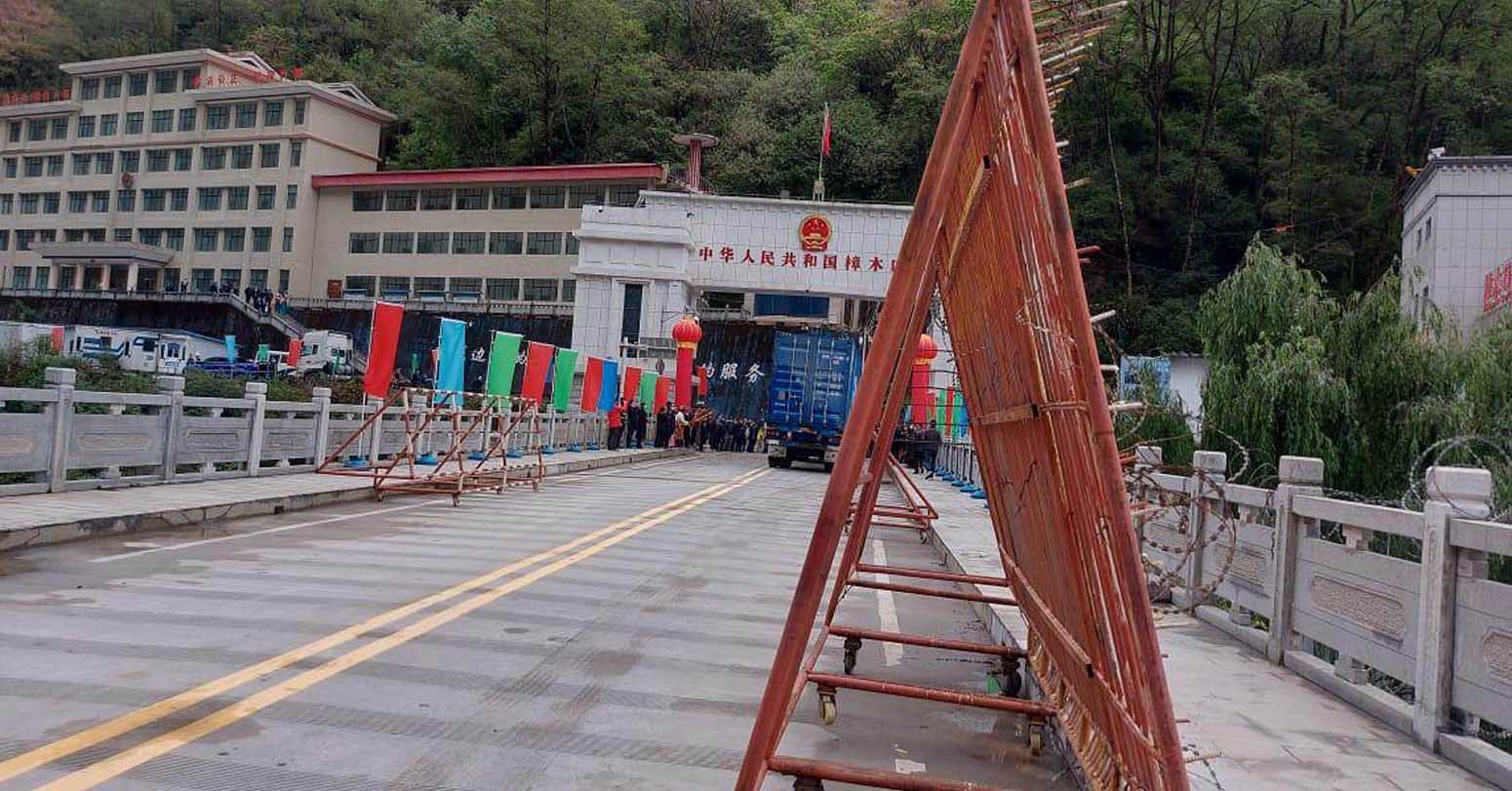
Zhang: Transportation is the top priority issue. The historical transportation routes between China and Nepal are now facing severe geological challenges that require cooperation between the two countries to address. In addition, institutional and mechanism alignment is another area, especially in personnel movement and commodity trade, where there are still many links that can be prioritized to make it more convenient for businesses and individuals on both sides.
Q. As we talk about the cooperation between Nepal and China, Nepal always values China’s support, and expects more tourists, FDI and people to people exchanges but the trend has reduced in the recent past. Why this happened and how can we make our cooperation meaningful and tangible?
Zhang: Objectively speaking, Nepal is rich in tourism resources, but its supporting facilities are relatively backward and struggle to meet the requirements, including aspects such as the quality of transportation and others. In the past, Chinese tourists mainly engaged in sightseeing tourism, which had lower requirements for infrastructure. However, Chinese tourists are now increasingly inclined toward leisure tourism, which raises the bar for infrastructure. In this regard, Nepal still has significant room for improvement. If Nepal can substantially upgrade its tourism infrastructure, I believe Nepal’s tourism industry will experience a leap forward.
Q. You are also a South Asia expert from China and have worked in the region for the diplomatic assignment, how do you view the scope of China-South Asia relationship?
Zhang: China’s relations with South Asia are primarily based on historical and cultural dimensions. The level of development of relations between sovereign states remains limited. Economic and trade ties between China and South Asian countries are generally weak, and cultural and people-to-people bonds are also very limited. This is not commensurate with China’s neighboring relationship with South Asia and the massive population scale of both sides. However, this precisely shows that there is enormous room for growth in China-South Asia relations. With the rapid development of South Asian countries, China’s comprehensive relations with South Asia will further strengthen.
Q. And some scholars and politicians in Nepal give more emphasis on Nepal-India-China trilateral relationship. Do you have further ideas to further cement this concept?
Zhang: I do not think the concept of a “trilateral relationship” is appropriate. From the perspectives of geography and scale, Nepal should be more of a bridge rather than a third party. Of course, Nepal’s relations with China and India influence each other. Nepal’s foreign policy is not complicated—it is simply to remain neutral and maintain friendly relations with both China and India simultaneously. Nepal may consider leveraging its Himalayan geographical characteristics and take on the role of promoting a trans-Himalayan economic zone or economic corridor, with the goal of integrating cultural and tourism resources. For example, Hindu and Buddhist pilgrimage routes actually span two or even three countries. If deep people-to-people tourism routes crossing the three countries’ borders can be promoted, it will not only bring economic value to Nepal but will also play a major role in regional integration and in promoting regional stability and peace.
Q. This is because Nepal wants to become a vibrant bridge between two great civilizations in its south and north, and take advantages of the massive development both in China.
Zhang: Nepal should instead leverage its own cultural, historical, and location advantages, giving priority to developing cultural and tourism industries to attract tourists from both China and India. Nepal may not need to develop large-scale manufacturing like China and India, nor is it possible.
Q. In this context, ruling RSP has announced to give priority to ‘Development Diplomacy’. How do you see the scope of this concept?
Zhang: Development is a core concept for all countries, but the connotation of development differs from country to country. It is correct for the RSP to take development as its core goal; this also reflects the aspirations of the broad Nepali people, especially the youth. This concept should be good news for China-Nepal relations. China’s development model can provide Nepal with some experience and reference. What needs to be noted is that development and aid are different concepts. Aid only requires receiving; it is often one-way. Development, on the other hand, is interactive between both sides, sustainable, and mutually beneficial. Therefore, a development-oriented approach is completely different from an aid-oriented approach.
Q. Do you have any ideas that how Nepal can get more benefits from development spillover of its neighbours. Or does this spillover effect make any difference in economic development for neighboring countries?
Zhang: Nepal needs to shift from “passively benefiting” to “actively shaping.” By systematically integrating its geographical location, human resources, and ecological advantages, Nepal can transform itself from a regional periphery into a strategic hub and gain greater voice and economic benefits. Specifically, on one hand, it can develop a corridor economy and use Nepal’s favorable diplomatic environment to turn Kathmandu into a hub for green economy and renewable energy in South Asia. On the other hand, it should focus on developing labor-intensive industries (leveraging the demographic dividend) and high-value services (digital economy, education). In addition, it can utilize the Himalayan ecological advantages to develop carbon credit trading, eco-tourism, renewable energy exports, and other industries.
Q. Finally, how do you assess the BRI cooperation between Nepal and China? And, how you expect to make a breakthrough in the BRI cooperation in Nepal.
Zhang: China and Nepal signed a BRI cooperation agreement as early as 2017, but progress has been slow, with many cooperation agreements still remaining on paper. This is caused by multiple factors. Objectively speaking, Nepal’s scale is relatively small, and it was indeed difficult for large BRI projects in the early stage to take root, as Nepal could not absorb them. For example, in some hydropower cooperation projects, the electricity generated could not be consumed by Nepal, leading to reverse constraints from third-country consumer markets. But now, the BRI has entered its second stage, placing greater emphasis on small yet beautiful green development projects and sustainable development projects.
In this context, the prospects for cooperation between China and Nepal have actually improved. In the future, China and Nepal should explore new approaches: First, shift from an infrastructure-oriented approach to an industry-oriented approach.
Establish “China-Nepal Industrial Parks” and build industrial parks around Kathmandu to attract the relocation of Chinese small and medium-sized manufacturing enterprises. Priority should be given to labor-intensive industries, such as textiles, light industry, and food processing, to fully utilize Nepal’s advantage in labor costs.
Second, resolve the triangular tensions in bilateral cooperation. Consideration can be given to incorporating China-Nepal cooperation projects into a broader SAARC cooperation framework or international frameworks.
Third, attract investment and capital from both China and India, and create conditions to welcome the transfer of capital and technology. In the past, there was a structural mismatch in China-Nepal BRI cooperation. China mainly promoted major infrastructure construction at that time, but what Nepal needed most was industrial development and income growth. In the second stage of the BRI, the structural mismatch between China and Nepal will have the opportunity to be narrowed.
Janai Purnmina Being Marked Today
Catastrophic Flash Flood In Bhotekoshi
Water Level Again Increases In
Rasuwa’s Road Connection Restored
Forgiveness Ritual Held At Palanchowk
Bhotekoshi Flashflood: Rs 1.91 Billion