






















Although the Supreme Court has invalidated the government's decision to restrict government advertisements to state-owned media, the prohibition on publishing procurement-related notices in newspapers remains in force under the amended Public Procurement Act.
The Supreme Court recently overturned the decision of the Office of the Prime Minister and Council of Ministers, dated 18 Chaitra 2082, which directed that government advertisements be published exclusively through government-owned media. However, government officials have clarified that advertisements related to public procurement, including bid invitations and notices, continue to be prohibited from publication in newspapers due to existing legal provisions.
The government led by Balendra Shah (Balen) had directed that government advertisements be published only through Gorkhapatra, Radio Nepal, and Nepal Television, excluding private media. Around the same period, the government introduced the Second Amendment to the Public Procurement Act, 2063 through an ordinance.
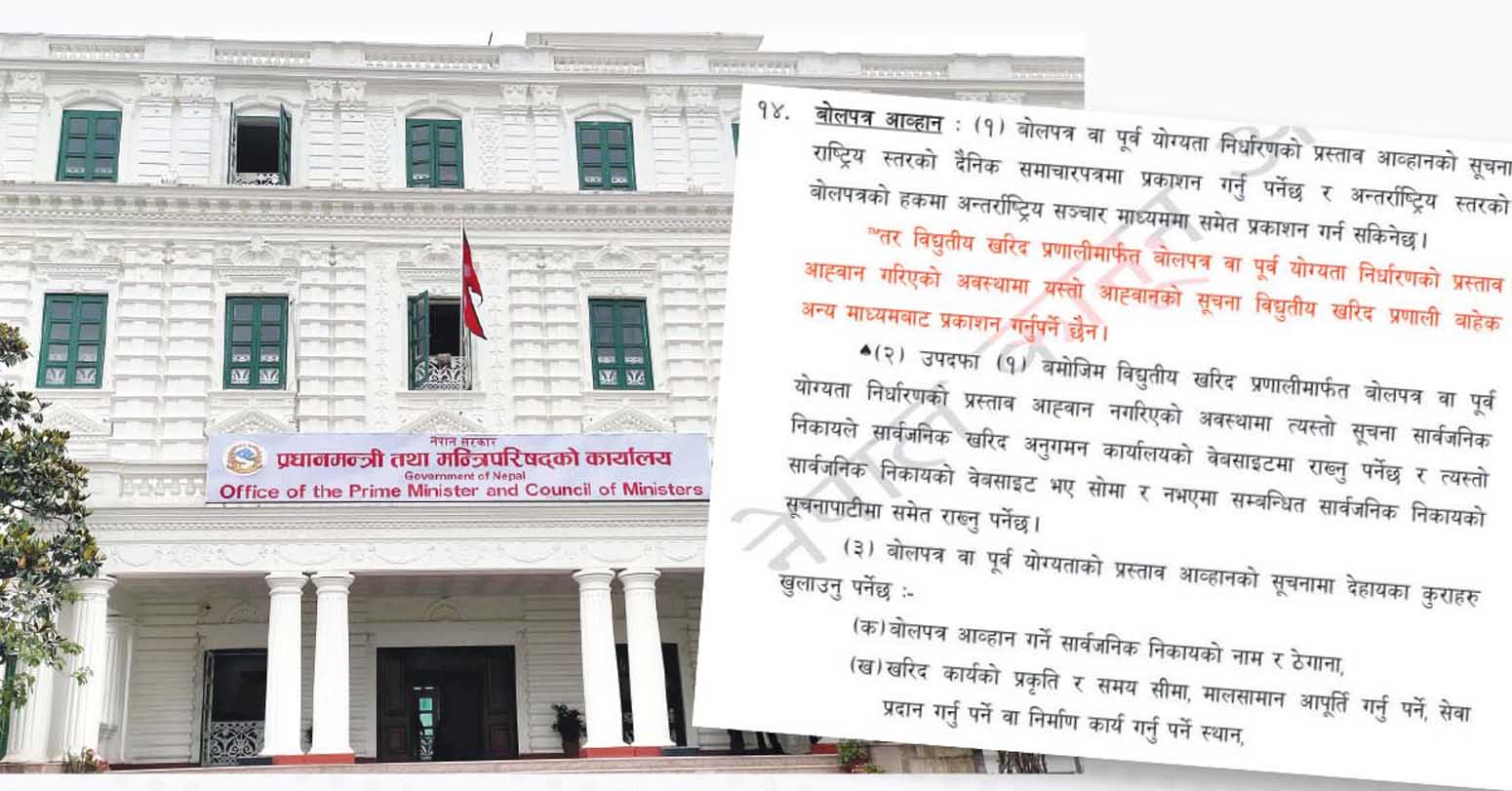
The ordinance, published in the Nepal Gazette, amended Section 14 of the Act by providing that where bids or prequalification proposals are invited through the electronic procurement system, the relevant notices shall be published exclusively through that system. Unlike the previous legal framework, which required bid notices to be published in newspapers, the amended provision eliminated the requirement for newspaper publication and mandated electronic publication instead.
Government officials maintain that, because the amended law prohibits the publication of procurement notices in both private and state-owned newspapers, such advertisements cannot legally be published in print media.
Parliamentary Endorsement of the Amendment
The ordinance introducing the electronic publication requirement was subsequently replaced by a bill, which received support from both the ruling and opposition parties and was passed by the House of Representatives and the National Assembly.
Officials argue that, because Parliament has enacted the amendment into law, procurement-related advertisements and notices are no longer required—or permitted—to be published in newspapers. Consequently, despite the Supreme Court's decision striking down the government's discriminatory advertising policy, procurement notices remain excluded from both private and government newspapers unless the law is amended.
A Under-Secretary at the Ministry of Infrastructure Development explained that, following Parliament's amendment to Section 14 of the Public Procurement Act, neither bid invitation notices nor letters of intent relating to procurement may be published in any newspaper. Accordingly, federal, provincial, and local governments are legally prohibited from publishing procurement notices in newspapers unless the statutory provision is repealed or amended.
However, the restriction applies only to procurement-related notices. Government advertisements concerning public awareness campaigns, recruitment, and other non-procurement matters may continue to be published or broadcast through all forms of media, including private newspapers, online platforms, radio, and television.
Nevertheless, the removal of procurement advertisements has had a significant financial impact on newspapers, as such notices have traditionally constituted a major source of advertising revenue.
The Way Forward
Restoring the publication of procurement notices in newspapers will require a legislative amendment to the Public Procurement Act itself.
Following Parliament's enactment of the replacement bill, Section 14(2) of the Act now provides that where bids or prequalification proposals are not invited through the electronic procurement system, the relevant public body must publish the notice on the website of the Public Procurement Monitoring Office and, where applicable, on its own official website. The amended provision no longer requires publication in newspapers.
Since this requirement has been removed by statute, reinstating mandatory newspaper publication would require Parliament to amend the Act once again.
Meanwhile, a constitutional challenge to the amendment introduced through the ordinance remains pending before the Constitutional Bench of the Supreme Court. The Court's forthcoming decision will determine whether the amendment to the Public Procurement Act is upheld or declared unconstitutional.
Supreme Court Decision on Government Advertising
In a separate ruling, the Supreme Court has directed the government not to undermine freedom of expression and communication by restricting government advertising.
The full text of the judgment, made public on Wednesday, relates to the Court's decision of 10 Ashad 2083. A joint bench comprising Justices Saranga Subedi and Nripa Dhwoj Niroula declared unlawful the Office of the Prime Minister and Council of Ministers' decision of 18 Chaitra 2082, which had instructed all government bodies to publish advertisements exclusively through state-owned media.
The Court held that neither the Constitution nor the Mass Communication Act, 2076 authorizes the government to discriminate between public and private media when disseminating government information or advertisements. It concluded that the decision adversely affected the constitutional rights to communication and freedom of thought and expression and therefore could not be sustained.
Accordingly, exercising its authority under Article 133(2) and (3) of the Constitution of Nepal, the Supreme Court declared the government's decision and the related circular issued by the Secretary of the Office of the Prime Minister and Council of Ministers null and void.
Arguments Presented Before the Court
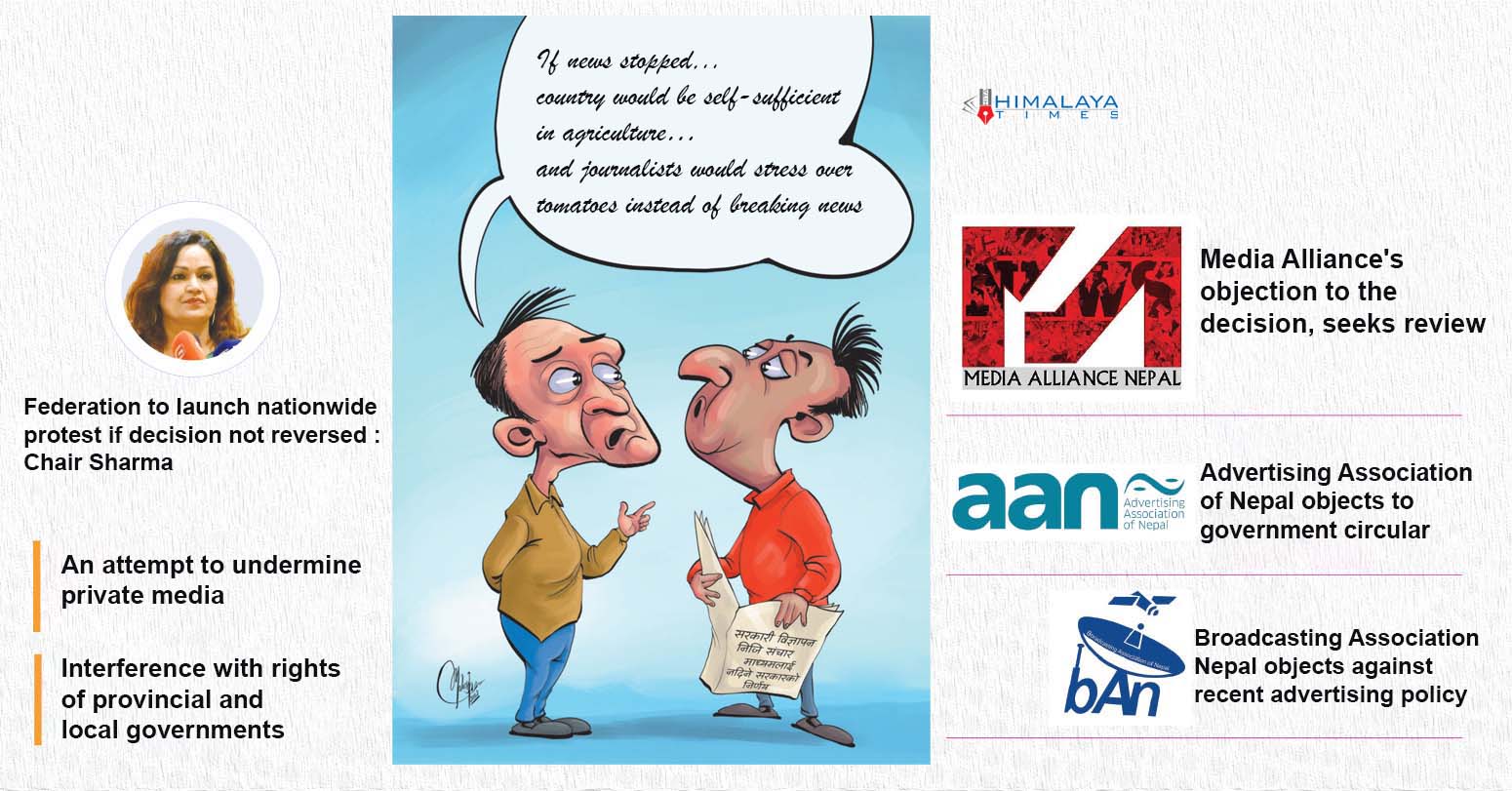
Legal practitioners representing media organizations argued that the government's policy effectively sought to weaken independent media by depriving private outlets of a long-standing source of advertising revenue. They contended that the Advertising Act and its regulations require government advertisements to be distributed proportionately among eligible media organizations and that the government cannot selectively favour certain outlets while excluding others.
The petitioners further argued that the government had exceeded its authority by bypassing the jurisdiction of the Advertising Board and by directing provincial and local governments to follow a centralized advertising policy.
The disputed circular, issued following a secretary-level decision on 18 Chaitra 2082, instructed all ministries, departments, provincial governments, local governments, and publicly funded institutions to publish government advertisements and notices exclusively through Gorkhapatra Sansthan, Radio Nepal, Nepal Television, and other government-owned media. The Supreme Court has now invalidated that directive, reaffirming that government advertising policies must comply with constitutional guarantees of equality, freedom of expression, and non-discrimination.
Janai Purnmina Being Marked Today
Catastrophic Flash Flood In Bhotekoshi
Water Level Again Increases In
Forgiveness Ritual Held At Palanchowk
Bhotekoshi Flashflood: Rs 1.91 Billion
Rasuwa’s Road Connection Restored