
















In a parliamentary democracy, the stronger the government, the greater the necessity for a robust opposition. The principal opposition serves not only as an alternative to the ruling authority but also as a mechanism for accountability, identifying governmental shortcomings and guiding corrective action. However, when a government commands a two-thirds or near two-thirds majority, the opposition is significantly diminished in representation. Consequently, as the government grows stronger, the opposition correspondingly weakens. In such circumstances, the absence of a strong corrective force can lead to arbitrariness, procedural violations, and the concentration of power in individuals.
When parliamentary opposition is ineffective, the responsibility of holding the government accountable increasingly shifts to the public. For this to occur, citizens must have timely access to accurate information regarding governmental actions. Among various channels of information dissemination, the media plays a pivotal role and is often regarded as a “watchdog.” In Nepal, media can broadly be categorized into government-owned and non-governmental (private and community) outlets.
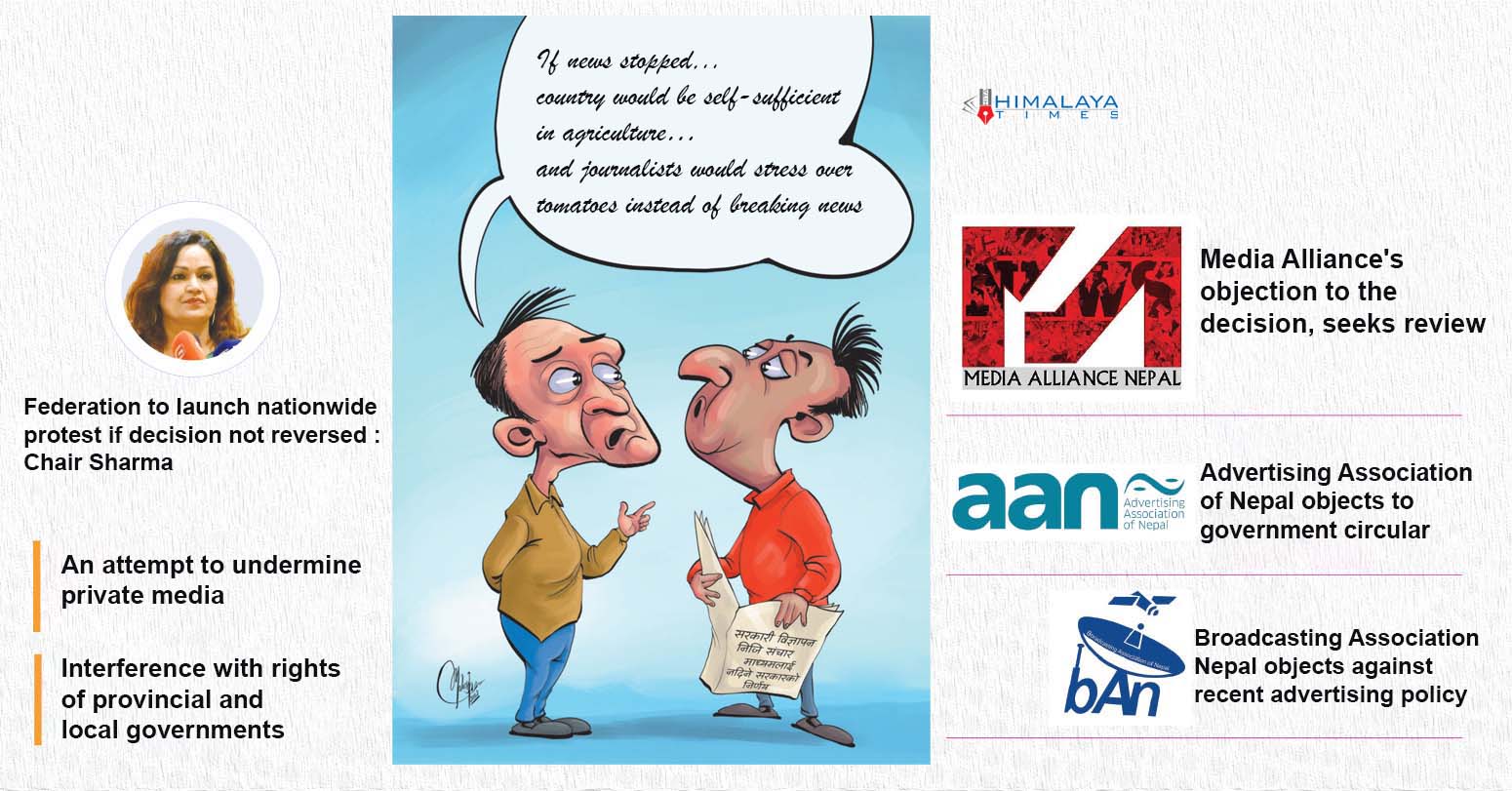
Government media has long faced criticism for functioning as a vehicle for state endorsement rather than scrutiny, thereby failing to fulfill an oppositional role. In this context, independent media becomes the primary instrument for ensuring accountability. However, concerns have arisen over governmental measures that appear to undermine private media. Policies restricting government advertisements exclusively to state-owned outlets are widely perceived as economically coercive, effectively imposing financial constraints on independent journalism. Such actions have been interpreted as encroachments on democratic principles, press freedom, federalism, and the public’s right to information.
Syndicate in government information
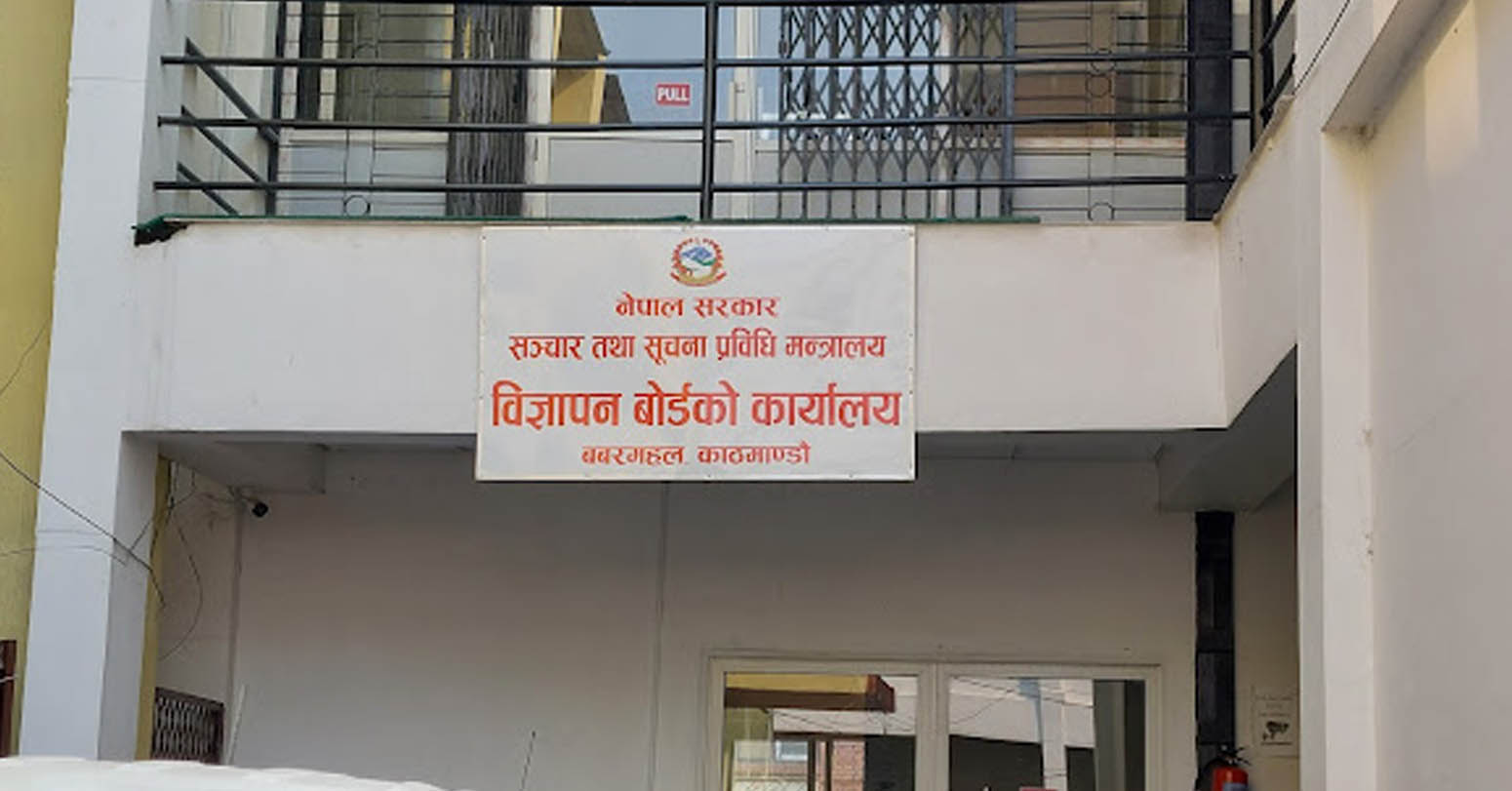
The government’s approach, framed as reform, has been criticized for marginalizing private media while privileging state-owned institutions. Advertising, beyond being a communication tool, constitutes a critical financial lifeline for media organizations. Its unilateral restriction is therefore viewed as equivalent to an economic blockade. Furthermore, limiting advertisements to a single medium narrows the reach of public information and raises concerns about favoritism and reduced transparency in processes such as public procurement.
This policy direction appears inconsistent with public expectations, particularly in light of electoral mandates emphasizing anti-corruption measures. Instead of addressing malpractice directly, the government is seen as attempting to control the advertising market through restrictive regulation. Constitutional guarantees ensuring citizens’ right to information are also called into question, as differential treatment between government and non-government media may undermine these rights and constrain press freedom.
Intent to control rather than regulate
Critics argue that the government’s actions reflect an intent to control rather than regulate the media landscape. Effective dissemination of information requires the inclusion of diverse platforms, including radio, television, print, online, and local outlets. Marginalizing these channels risks weakening the overall information ecosystem. At a time when misinformation can proliferate—particularly through social media—the role of credible and independent media becomes even more critical. The potential closure of private media outlets raises serious concerns about whether a single dominant source can adequately inform the public.
Although the government justifies its policy as a measure to address irregularities in the advertising sector, stakeholders question whether the solution lies in reforming the system or consolidating control. The broader issue is whether regulatory efforts should aim to ensure fairness and accountability or impose centralized authority over information dissemination.
Thousands of media workers at risk of unemployment
The implications of such policies extend beyond institutional concerns to socioeconomic consequences. The potential closure of private media threatens the livelihoods of thousands of journalists and associated workers, including those in printing, distribution, and related sectors. This not only jeopardizes employment but also risks creating a one-sided information environment and weakening the overall quality and independence of journalism. The contraction of the media industry could further impact education and training in journalism, affecting future generations.
Additionally, concerns have been raised about the emergence of a de facto monopoly in government advertising. Critics argue that privileging state-owned media contradicts the principles of an open market economy and may lead to the arbitrary use of public funds. As government advertising is financed by taxpayers, its allocation should reflect public interest rather than institutional preference. Current policies are thus perceived as protecting government media while disadvantaging private outlets.
When will media owners achieve unity?
The issue is further complicated by a lack of consensus among private media stakeholders. While some advocate for transparency, equitable distribution, and standardized criteria, others accept preferential treatment for state-owned media. This divergence highlights underlying challenges within the media sector, including competing interests and influence dynamics.
At its core, the issue extends beyond advertisement distribution to the broader imbalance within the media economy. Unequal access to advertising revenue disproportionately affects small and medium-sized outlets, potentially undermining media pluralism and independence in the long term.
Addressing these challenges requires the establishment of clear policies, transparent standards, and independent regulatory mechanisms. Criteria such as audience reach, content quality, regional representation, and public interest should guide the allocation of government advertisements. Equally important is the need for collective understanding and cooperation among media stakeholders to safeguard the long-term integrity of the sector.
Ultimately, the distribution of government advertising is not merely an economic concern but a matter intrinsically linked to democratic governance. Ensuring fairness, inclusivity, and transparency in this domain is essential to maintaining a free, diverse, and credible media environment.
Middle-aged man spends millions to
Dr. Dharam Raj Upadhyay: Man
Children, Greatest Victims Of Sudan’s
Breathing The Unbreathable Air
Comprehensive Data Protection Law Critically
Gender Differences In Mental Healthcare